English
English is taught everyday in the forms of reading and writing at Southmead, and is one of the most crucial subjects in our Curriculum! We work hard to inspire and engage our children with exciting books and stimulus to encourage a real love for reading and writing at Southmead.
Intent - Writing
At Southmead Primary School, we intend for our writing curriculum to inspire pupils’ curiosity about words and language: We aim for pupils to develop a love of words, a love of written language, and appreciate writing as something that is done for pleasure, as well as purpose. We would like our children to become knowledgeable, reflective and creative writers, who can effectively transcribe and compose, as well as manipulate words and language for effect. All children from Nursery to Year 6 are provided with many opportunities to develop and apply their writing skills in all areas of the curriculum.
By exposing our children to a range of high quality literature and by giving them purposeful tasks, we will enable them to develop their writing in a safe, supportive way. We intend for all pupils to know the intended purpose, audience and characteristic features and literary techniques of different styles of writing. To achieve this, pupils will be taught to plan, draft, revise and evaluate their own writing. When editing, pupils will become skilled in considering the reader and how making such additions and improvements can enhance their experience.
Resilience is a key value that we shall develop within our pupils to help them overcome any challenges that writing may bring. We intend to equip them with strategies and knowledge of a range of different resources to aid their independence and confidence when writing. We aim for all pupils to leave school being able to use fluent, legible and speedy handwriting and to use an increasing wide range of vocabulary and grammar techniques within their compositions
Implementation - Writing
At Southmead, we are developing a research based writing curriculum which the supports the children to become confident writers. Our aim is to explicitly teach the different motivations for writing and encourage children to write for a range of purposes, as well as for the joy of putting pencil to paper. We are beginning to encourage children to work together as a community of writers and model the writing process (being an author) to the children via our modelled, shared and guided writing. We plan engaging writing units which begin with an exciting hook to immerse the children into the writing process and sustain enjoyment throughout. We recognise the importance of grammar, punctuation and spelling and teach these both implicitly and explicitly, through our shared and guided writing process. We acknowledge the importance of building the children’s stamina in writing and are beginning to build this into our planning so that this can be practised daily. This could be within English lessons, during early morning work or within Science and foundation lessons, as we understand that the quality of writing in English lessons should and does feed into all other curriculum areas. As children become more confident and knowledgeable as writers, they are able to share this with their peers and are better able to apply this in other curriculum areas, deepening their understanding.
We employ cross curricular learning to ensure that children learn and begin to master discipline specific genres involved in other parts of the curriculum, such as historical recounts, geographical non chronological reports and scientific reports. Our pupils understand what and why they are writing, as we make this explicit through our teaching. For example, each writing unit begins with an explicit purpose whereby children are aware of their future audience and where their writing may end up. This could either be in the form of a competition, a whole school display or book for our class or school library. We believe this motivates the children to produce writing to a high standard. Before expecting the children to write, we teach why certain genres exist as well as their features, before encouraging the children to adopt these in their own writing. Our children recognise that writing is an ongoing process which is developed and improved through repeated practise, editing and improving.
At Southmead, we recognise that developing the child as a writer has a positive impact on children’s personal development. As children begin to develop their own writing process, they develop their writer identity which we, as teachers, routinely model. We encourage children to make a choice about what they wish to write about, within the parameters of a writing project, and try to make good use of this within our creative writing books and at our writing area. We recognise that writing is a form of expression and where possible allow the children to write about their own lives, thoughts, opinions, knowledge and imaginative ideas, as we believe this will increase writing for pleasure whilst at the same time shape the children’s personal identity. Our aim is for children to leave school with a pleasurable and recreational tool that can help to promote positive well-being and become a life – long pursuit.
As an IQM awarded school, we are passionate about supporting SEND pupils to develop as writers. We consistently simplify the writing process of planning, drafting and publishing. We use careful differentiation of tasks, storytelling, drawing, oral rehearsal and visual and audio resources to support the children when planning and drafting their writing. With the support of an adult and the relevant resources, children are taught to use a prompt board or check list to revisit, edit and redraft their writing, before moving on to publish small sections of their writing. We are developing the use of peer conferencing to support and improve the children’s writer’s voice.
As a school, we recognise that advanced and highly experienced writers also need to be supported and challenged and we develop this in a number of ways: we encourage more advanced writers to use their creative writing books to write freely as regularly as possible, taking on and experimenting with more advanced literary techniques; and we use peer conferencing to ensure that the children learn from one and other and edit and improve their writing so that it has a distinct writer’s voice. Our more advanced writers are given a greater freedom in relation to their own writing process, the strategies they employ and how they wish to present their writing which we believe creates greater writer autonomy and increases creativity.
The staff at Southmead recognise the importance of teacher subject knowledge in the successful teaching of writing. We understand the importance of the purpose and audience for writing and take care to ensure that we have planned for this. We recognise that genres are subject to change, are often interconnected and can serve more than one purpose and aim to ensure that we are covering a broad balance of genres throughout the school. Our developing pedagogical knowledge is based on scientific research into the most effective ways to teach writing, case studies of what the best performing teachers do to make a difference to writing, our own school principles and the wisdom of established and professional writers. We are creating and developing a writing curriculum which is based on Ross Young’s 14 principles of world- class writing teaching:
1. Build a community of writers
2. Ensure every child is a writer
3. Read, share, think and talk about writing
4. Plan purposeful and authentic class writing projects
5. Teach the writing processes
6. Set writing goals
7. Be reassuringly consistent.
8. Provide time for personal writing projects
9. Balance the teaching or composition and transcription
10. Teach daily mini lessons (For example during early morning work)
11. Be writer-teachers
12. Give high quality feedback through pupil conferencing and through responsive mini lessons
13. Connect reading and writing.
14. Interconnect the principles of world class writing teaching
At Southmead, we place great importance on the how teachers check pupils’ understanding and set future writing goals. We are beginning to use pupil conferencing to collaboratively assess the effectiveness of our writing and the children’s understanding. Children are aware of their personal writing target and the expectation is that each child will try to achieve it in every composition. Following this, teachers routinely assess and reflect on the gaps in their children’s knowledge and consistently adapt their teaching and planning to reflect this.
As a school, we aim to ensure that the key knowledge and skills taught within the writing process are committed to children’s long-term memory. Our working walls support the children’s understanding and clearly display the writing process in an accessible location in the classroom. We believe that the progression of our genres, sentence structures and progression in writing as a whole allows the children’s knowledge to be built upon throughout the years and stored in their long-term memories.
Supporting your child with writing at home.
25 Writing Tasks to do at home:
More exciting creative writing tasks to try with your child:
Tasks for children with SEND:
Intent - Reading
At Southmead Primary, reading is a top priority and is a key driver for our curriculum. We highly value reading as a key life skill, and are dedicated to enabling pupils to become lifelong readers. Through reading vocabulary rich material, pupils have a chance to develop culturally, emotionally, intellectually, socially and spiritually. We intend to encourage pupils to read widely across both fiction and non-fiction to develop: knowledge of themselves and the world in which they live; to establish a love of reading; to gain knowledge and ensure access to the wider curriculum; and develop comprehension skills. It is our intention to ensure that all pupils are able to read fluently and with confidence, in any subject.
Implementation - Reading
Southmead follows an inclusive pedagogy based on whole class reading. As a class, each reader will read and analyse the same text and is supported through high-quality teacher modelling. Throughout EYFS and Key Stage one and across KS2 where appropriate, pupils follow a rigorous system of synthetic phonics following the Little Wandle Letters and Sounds Revised – a systematic and synthetic phonics programme. We start teaching phonics in Nursery/Reception and follow the Little Wandle Letters and Sounds Revised progression, which ensures children build on their growing knowledge of the alphabetic code, mastering phonics to read and spell as they move through school.
Whole class reading starts with the children in Year 1. The children are taught reading with phonetically decodable books that correspond with the children’s phonics learning throughout the Little Wandle Letters and Sounds Revised. In Year 1, the children read Big Cats phonics books in their whole class reading and take Project X phonics books home. By Year 2 our children are working well into phase 6 and can then apply their phonic knowledge to a wider range of texts. Wider opportunities are given to apply phonics knowledge throughout the day and across the curriculum in speaking, reading and writing.
Whole class reading allows for reading to be taught as a lesson with the teacher modelling to all of the children every day over the week. Whole class reading texts are linked closely across the school’s picture curriculum and support the children’s English learning. Reading lessons over a unit will include:
- a hook lesson to engage and excite the children with any new text;
- an element of prosody (reading with feeling) modelled to the children by the teacher;
- ‘Goldilocks’ or ‘tier 5’ vocabulary that is picked from the text and taught to the children daily as a vocabulary starter and is supported with activities to embed the new vocabulary;
- a copy of the text for every child;
- opportunities to teach reading expression, prosody and to take notice of the author’s style and use of punctuation;
- regular, open ended discussions about the text;
- clear learning objectives from the National Curriculum that are see linked to the very popular Domain dogs (Rex Retriever, Summarising Sheba, Inference Iggy, Predicting Pip, Presentation Percy, Vocabulary Victor, Arlo Author and Cassie Commentator);
- specific skills that are taught to the children that enable them to understand the strategies needed to identity a comprehension question’s domain and how to answer it;
- opportunities to peer or self-mark during the lesson maximising the opportunity for immediate feedback;
- opportunities to be challenged in the lesson with additional challenge questions to stretch our more able readers;
- opportunities to compare and discuss texts from a wide range of genres including poetry and non-fiction (including weekly newspapers to ensure children are aware of local, national and global issues.) and
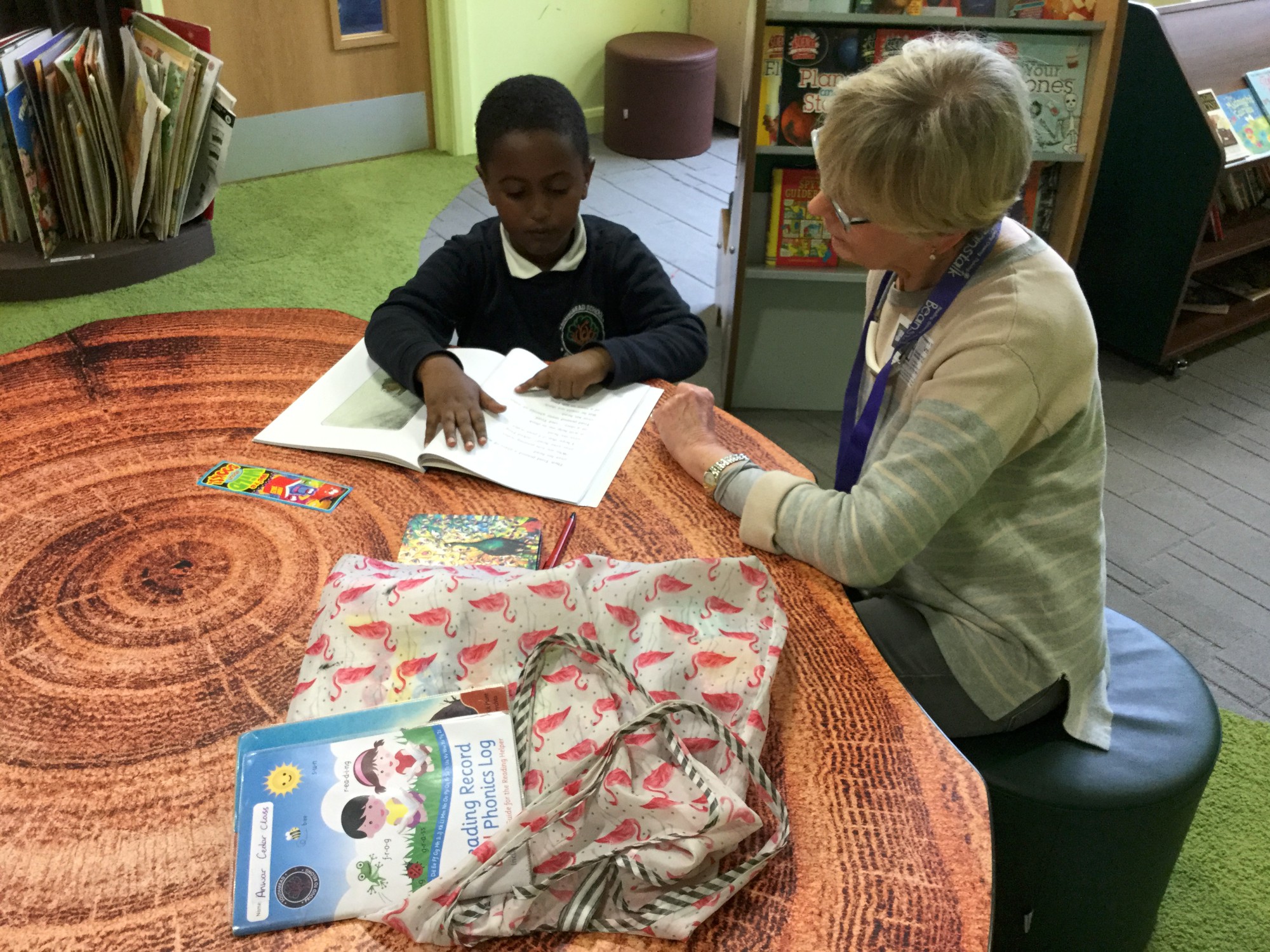
In addition 1:1 daily reading is put into place for children who need extra practice and teaching assistants run weekly interventions following ’60 seconds read’ to improve the reading fluency of children working below the national expected standard.
At Southmead we also have our class story time timetabled daily at 1.15 (KS2) and 3.00 (KS1) and a school library which is open daily and run by our Year 6 librarians. Children record their home reading in their reading diaries which are closely monitored by teaching staff. We work hard to promote a love for Reading with our parents and children. We regularly host reading breakfasts where we can invite parents into the school hall to share books with their children and enjoy some breakfast snacks.
We have the pleasure of working with charities such as ‘Learn to Love to Read’ that further support our children’s reading. Celebrating Reading is a big part of our school culture at Southmead. We have regular visits from our local librarian from Southfields Library and we enjoy visiting our community library throughout year.